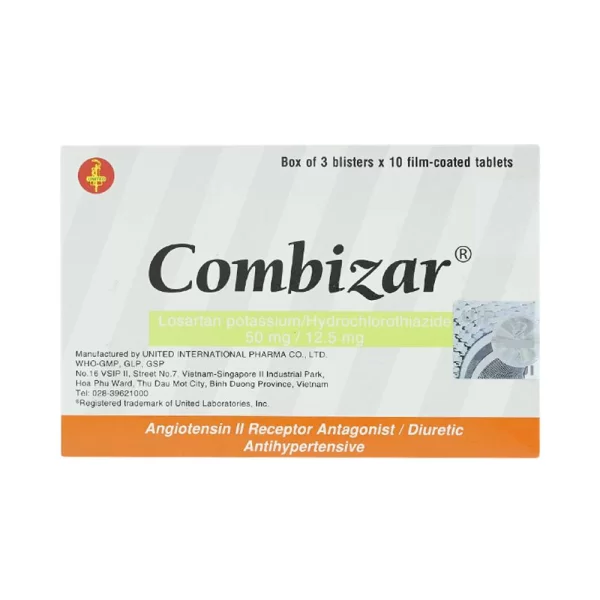
Indications
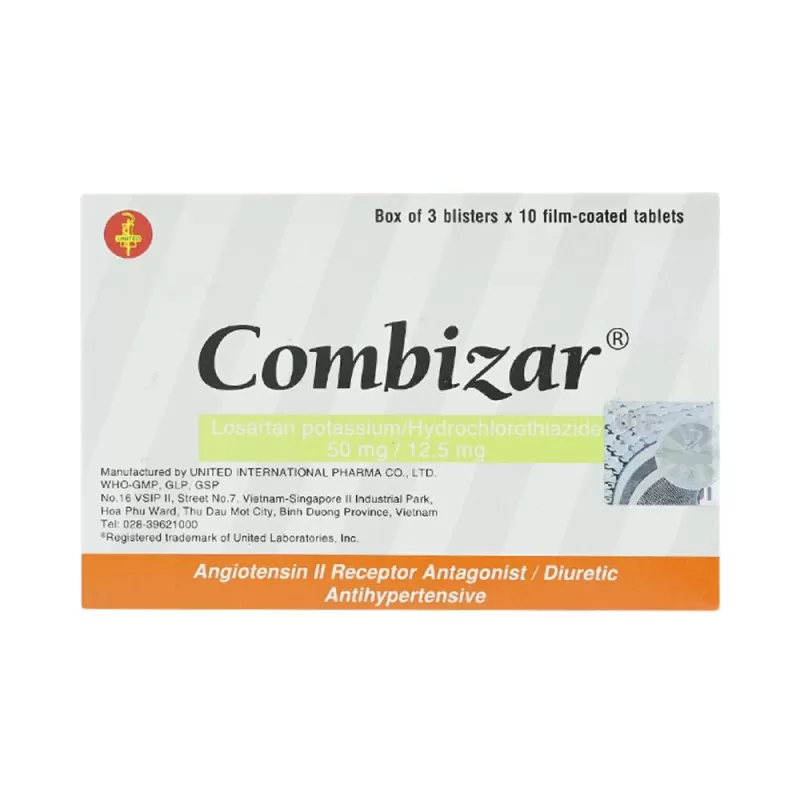
To treat hypertension in whose tension is not controlled properly with losartan and hydrochlorothiazide alone.
To reduce the risk of stroke in patients with hypertension and left ventricular hypertrophy
Contraindications
Known hypersensitivity to any of the active substances or excipients of the product, to thiazides and derivatives of sulfonamides. Manifest gout, anuria, Addison’s disease, hypercalcemia, hyperuricemia, severe hepatic and renal insufficiency (creatinine clearance < 30 ml/minute). Refractory hyponatremia. 2nd and 3rd trimester of pregnancy.
Compositon/Ingredients
Losartan 50mg, Hydrochlorothiazide 12.5mg
Dosage and administration
Hypertension One tablet of Combizar 50mg/12.5mg once daily. If blood pressure remains uncontrolled after about 3 weeks (or 2-4 weeks in case of severe), the dose may be increased to one tablet of Combizar 50mg/12.5mg once daily.
The maximum dose is one tablet of Combizar 50mg/12.5mg once daily. Hypertensive patients with left ventricular hypertrophy A initial dose of losartan is 50 mg once daily. One tablet of Combizar 50mg/12.5mg substituted if the blood pressure reduction is inadequate. If additional blood pressure reduction is needed, Combizar 50mg/12.5mg may be substituted, followed by Combizar 50mg/12.5mg.
Precaution
This fixed dose combination is not indicated for initial therapy of hypertension, except when the hypertension is severe enough that the value of achieving prompt blood pressure control exceeds the risk of initiating therapy. Losartan should be used with caution in patients with renal artery stenosis. Reduction doses may be required in patients with renal impairment and should be considered in patients with hepatic impairment. Combizar 50mg/12.5mg is not recommended for patients with hepatic impairment who require titration with losartan. Thiazides should be used with caution in patients with impaired hepatic function or progressive liver disease. Patients with volume depletion, volume depletion should be corrected before starting therapy, or a low initial dose should be used. Periodic determination of serum electrolytes should be performed. Thiazides have been shown to increase the urinary excretion of magnesium; this may result in hypomagnesemia. Since hyperkalaemia may occur, serum-potassium concentrations should be monitored, especially in the elderly. Hyperuricemia may occur or frank gout may be precipitated. Increases in cholesterol and triglyceride levels may be associated with thiazide diuretic therapy. Thiazide therapy may impair glucose tolerance and hyperglycemia. Hypersensitivity reactions to hydrochlorothiazide may occur in patients with or without a history of allergy or bronchial asthma. Thiazide diuretics have been reported to cause exacerbation or activation of systemic lupus erythematosus. The antihypertensive effects of the drug may be enhanced in the post-sympathectomy patient. When pregnancy is detected, losartan should be discontinued as soon as possible. A decision should be made whether to discontinue nursing or discontinue the drug, taking into account the importance of the drug to the mother. Patients should be aware of how they react to drug before driving or operating machinery.
Storage
Store at temperature below 30°C, protect from light.